Stockpiling advice shows economies bracing for disruption, says GlobalData

For immediate release: 2 November 2026
Governments across Europe, Asia, and the US are asking people to keep emergency supplies at home. GlobalData, a leading intelligence and productivity platform, finds this causes only a short burst of extra buying because households buy once, in small amounts. The bigger issue is cost. Stronger supply chains, with more stock, backup suppliers, and better protection against disruption, are expected to keep costs higher for years. Businesses, taxpayers, or households must carry that recurring cost.
The UK Cabinet Office launched its “Be Ready” campaign on October 22, 2026, as the first stage of a three-year program. As per the guidance, households should prepare for three days of disruption to power, water, and the internet, an approach already used in France, Ireland, and the Netherlands. The European Union’s Preparedness Union Strategy (March 2025) encourages at least 72 hours of self-sufficiency, and its Stockpiling Strategy (July 2025) builds an EU network to coordinate public stocks of essential goods. Sweden advises at least one week, and its “In Case of Crisis or War” brochure reached more than five million households in November 2024.
In the US, the Federal Emergency Management Agency (FEMA) launched National Preparedness Month on September 1, 2026, under the theme “Americans Stand Ready.” Its Ready.gov guidance asks households to store food, water, cash, and other supplies for at least three days, including at least 3.8 litres (one gallon) of water per person per day. Japan plans a national emergency request on November 2, 2026, asking households to hold at least three days of supplies, and ideally one week’s worth.
Why governments acting now
The UK’s National Audit Office (NAO) warned on September 4, 2026, that risks to the food supply chain are becoming more likely and potentially more severe. It noted that in 2025 the UK produced only about 60% of the food it consumed, by value, so it relies on imports for much of the rest. In Japan, the Cabinet Office puts the chance of a Nankai Trough megaquake at about 80% within 30 years, with up to 298,000 deaths in its March 2025 estimate. In the US, FEMA frames preparedness as protection against natural disasters and other emergencies that can strike without warning.
Arnab Nath, Associate Project Manager, Economic Research at GlobalData, comments: “Even if every household built a full three-day buffer, the effect would be a one-off rise in buying of shelf-stable food, water, batteries, power banks, flashlights, and radios. The more likely result is short-term shortages of a few products and distorted store promotions, rather than broad price increases across the economy. Prices are expected to settle once households have built their buffers.”
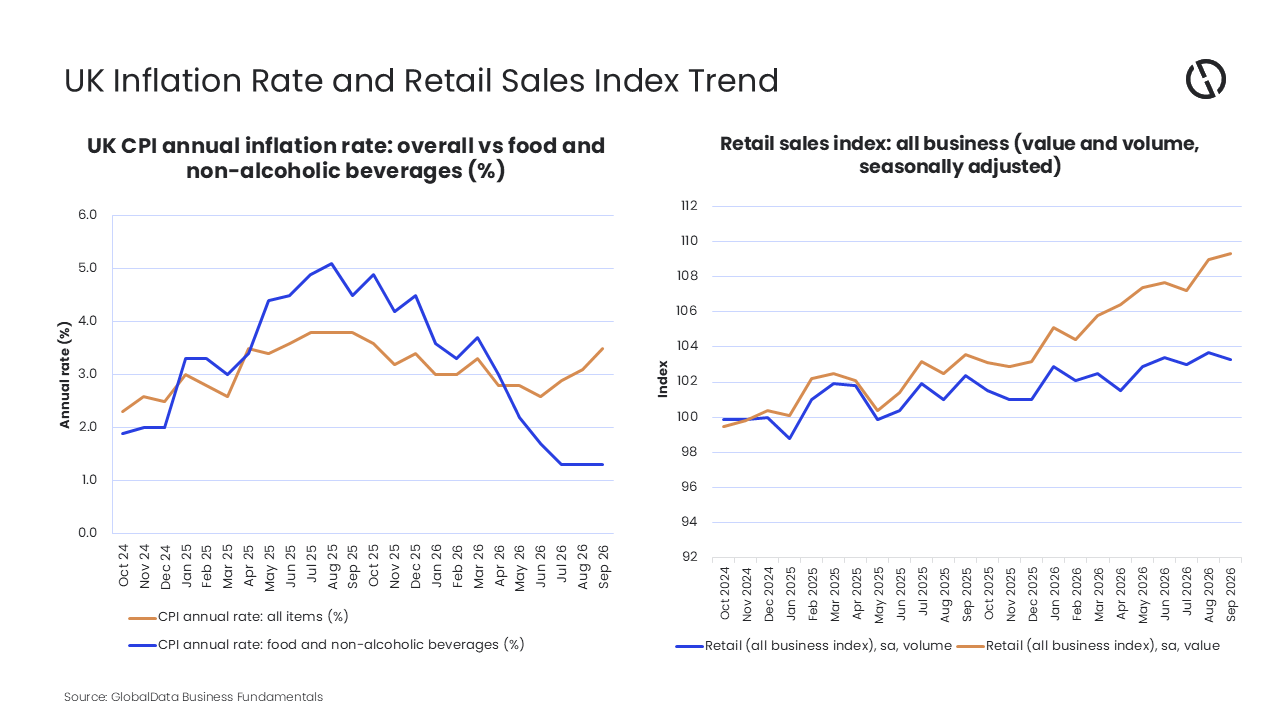
The UK data show prices rising before the advice. Overall CPI inflation rose from 2.6% in June 2026 to 3.5% in September, driven largely by transport costs, while food and non-alcoholic beverage inflation fell from 1.7% to 1.3%, well below its 5.1% peak in August 2025. Retail sales are growing, with the value index at 109.3, up 9.8% since October 2024, against 3.4% for volume at 103.3. The data predates the October 22, 2026, Be Ready launch, so any stockpiling effect is yet to appear.
Just-in-time becomes just-in-case
For decades, supply chains were built to be lean, holding little stock to minimize costs. The NAO notes that this efficiency lowers costs but increases vulnerability. Companies are now moving to a just-in-case approach, with more stock, backup suppliers, and stronger security, so that cyberattacks, bad weather, or conflict do not leave shelves empty. This is not free: more stock needs warehouse space, refrigeration, tied-up cash, and staff, which is expected to raise working-capital needs for food manufacturers, packaging suppliers, and retailers, adding gradual upward pressure on prices.
Who pays is the open question
Businesses may absorb the cost through lower profits, households may pay through higher prices, or taxpayers may fund public stockpiles and business support; in practice the cost is likely to be shared across all three. Household-led preparedness also shifts up-front costs to families, and the NAO acknowledges that these costs may be higher for some households. The UK advises building a kit gradually and offers free steps such as joining the Priority Services Register, which helps utility companies identify customers who need extra support, while the EU is moving part of the burden into public stockpiles. The cost is likely to weigh most heavily on lower-income households, which have the least room to pre-buy.
Risks to watch
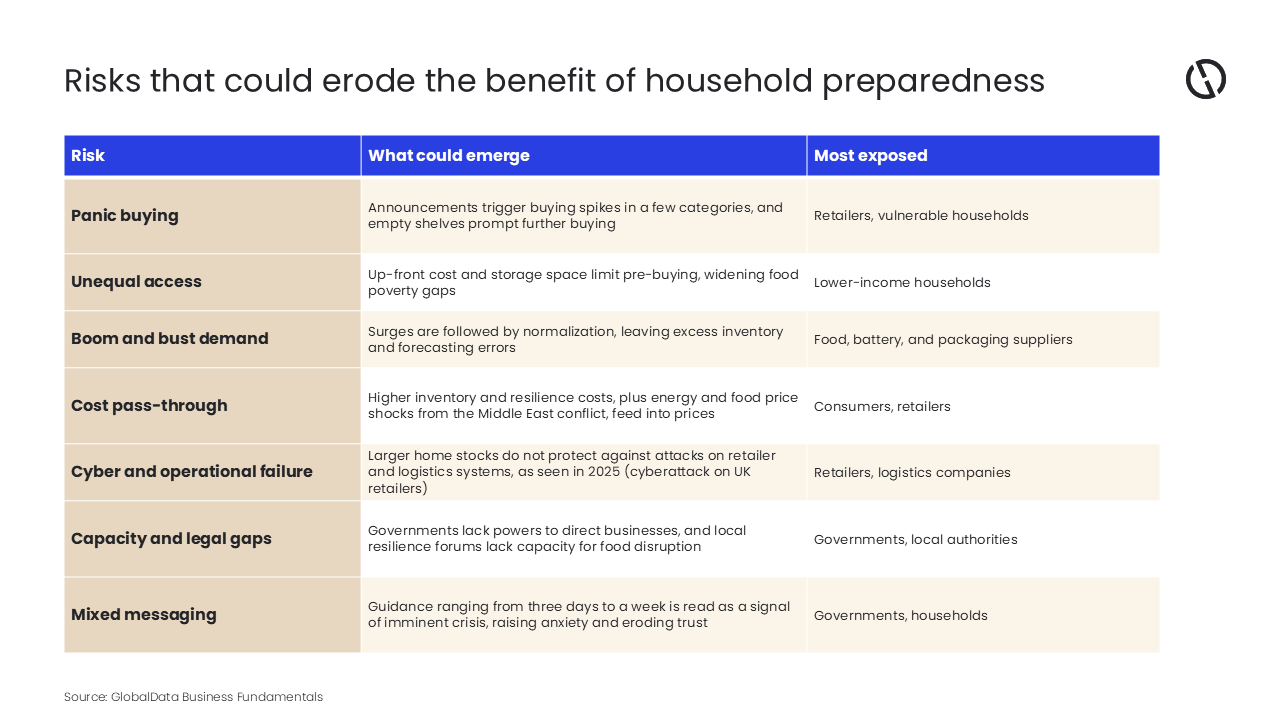
Preparedness advice carries its own risks, ranging from panic buying and unequal access to cyberattacks and gaps in government powers. The table below sets out seven risks that could erode its benefit.
Nath concludes: “Stockpiling advice is unlikely to move UK inflation much, as three days of food equals 0.8% of annual household food spending. The bigger question is who pays for resilience, because that choice is expected to shape prices and public spending for years.”
- Quotes provided by Associate Project Manager, Economic Research at GlobalData
- Information based on GlobalData’s Macroeconomic Database, “Country Analytics Overview – GlobalData”
About GlobalData
GlobalData Plc (LSE:DATA) operates an intelligence platform that empowers leaders to act decisively in a world of complexity and change. By uniting proprietary data, human expertise, and purpose-built AI into a single, connected platform, we help organizations see what is coming, move faster, and lead with confidence. Our solutions are used by over 5,000 organizations across the world’s largest industries, providing tailored intelligence that supports strategic planning, innovation, risk management, and sustainable growth.
L’article Stockpiling advice shows economies bracing for disruption, says GlobalData est apparu en premier sur Croissance Investissement.